Cadenvar Research
Project Synthetic Reality.
Could people one day use brain-computer interfaces to enter worlds generated by AI? We research the question by grading every claim it rests on, and we design software that shows where the evidence stops.
Research and design, not a product and not medical advice. Transfer of a mind or of experience into a machine has not been demonstrated in any organism, and nothing here claims it can be done. It is for information only and is not psychological or legal advice.
How we grade evidence.
- L1 Demonstrated
- Shown experimentally.
- L2 Several studies
- Supported by several independent studies.
- L3 Preliminary
- Small samples, one lab, a preprint or early clinical work.
- L4 Plausible in theory
- Consistent with what is known, not shown.
- L5 Speculative
- Goes beyond current evidence.
- L6 Unsupported
- Unsupported or contradicted by evidence.
Company statements are treated as claims, not findings, and are never graded L1 or L2 without published data. Preprints are labeled as preprints.
Four meanings of transfer.
People say transfer and mean different things. We keep four apart. Success at one is not success at the next.
(a) Information
Measuring and storing data about a brain.
Best result today: Wiring maps exist for the worm, the fly larva, the whole adult fly brain and about one cubic millimeter of mouse and of human cortex (L1 for those parts). A whole human brain: L4, plausible in principle.
(b) Functional copy
A system whose behavior and dynamics match the original at a stated level of detail.
Best result today: Fly circuit models built from wiring made some predictions later confirmed in live flies (L2). No whole-animal emulation exists for any species. A whole human brain: L5, speculative.
(c) Psychological continuity
Memories, beliefs and character carried forward by the right causal chain.
Best result today: Not shown in any organism (L4, theory only).
(d) Subjective experience
The same experiencing subject continues.
Best result today: Unsupported and untestable today (L5). No validated test separates a transfer of a subject from a copy.
Three designs.
On 2026-11-08 we designed three builds that use only public data and our own research notes. The screens below are design mockups and the names are working names.
Evidence Map
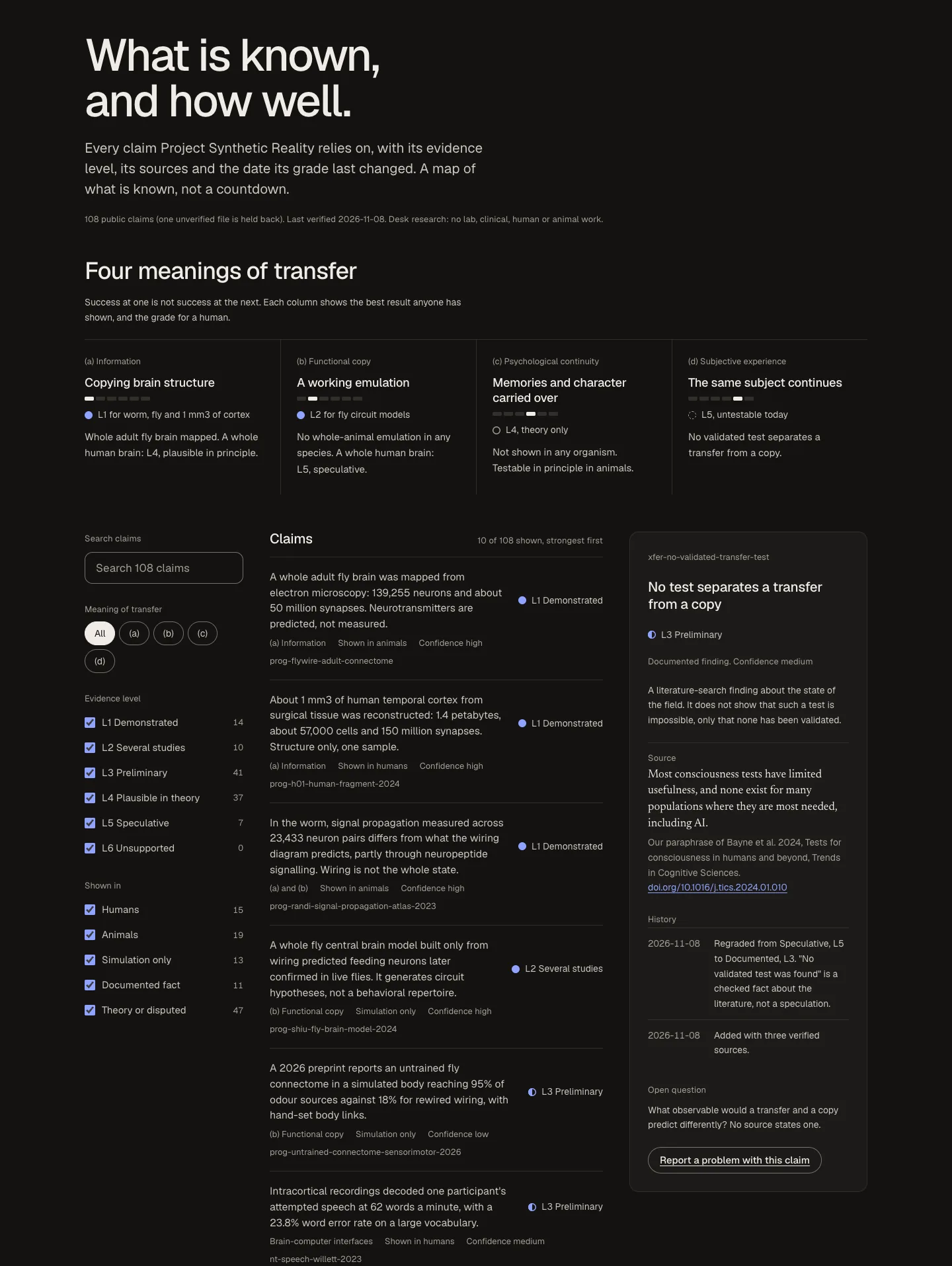
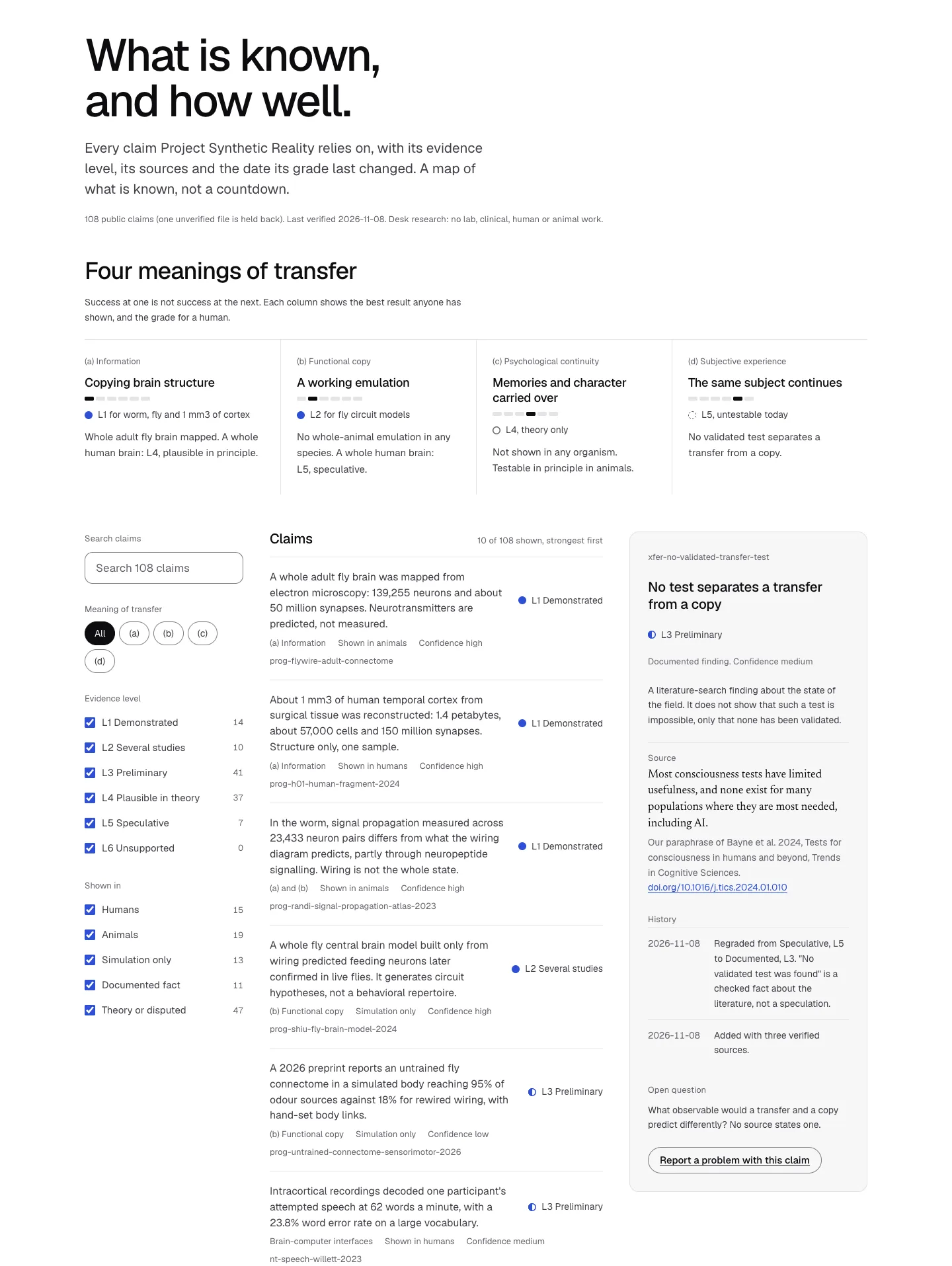
Every claim, its evidence level, its sources and its history.
Continuity Protocol
What would count as evidence for each meaning of transfer.
Open EEG Bench
Offline decoder scores on public EEG data, each with its controls.
Design 1
Evidence Map.
Every claim the project relies on, with its evidence level, its sources and a dated history of each grade change. Each level would appear as a word and a step on a six-step scale, never as color alone.
One graded example per level.
- L1 Demonstrated
- A whole adult fly brain was mapped: 139,255 neurons and about 50 million synapses. Neurotransmitters were predicted, not measured. (Dorkenwald et al. 2024)
- L2 Several studies
- A fly central brain model built from wiring predicted feeding neurons later confirmed in live flies. It generates circuit hypotheses, not a behavioral repertoire. (Shiu et al. 2024)
- L3 Preliminary
- Intracortical recordings decoded one person's attempted speech at 62 words a minute. One participant. (Willett et al. 2023)
- L4 Plausible in theory
- Psychological continuity as survival is a philosophical position, not a finding.
- L5 Speculative
- A brain-preservation company's claim that memories could be recovered for a later upload. Memory recovery from a preserved brain has not been shown.
- L6 Unsupported
- None yet. A claim that a subjective transfer has happened would land here.
Design 2
Continuity Protocol.
For each meaning of transfer: the result that would count as evidence, the controls it must beat, and what would not count.
Rules across all four.
No validated test separates a transfer of a subject from a copy. The protocol says what would count, not that anything does.
- No skipping. A result on one meaning says nothing about a higher one.
- Simulation is not experience. A simulation that ran says nothing about whether it felt anything.
- Company statements are capped. They reach at most L3 unless backed by published data, and at most L5 for claims about continuity or experience.
- Preregistration sets a ceiling. It lifts nothing by itself, but a functional copy or continuity result without it caps at L3.
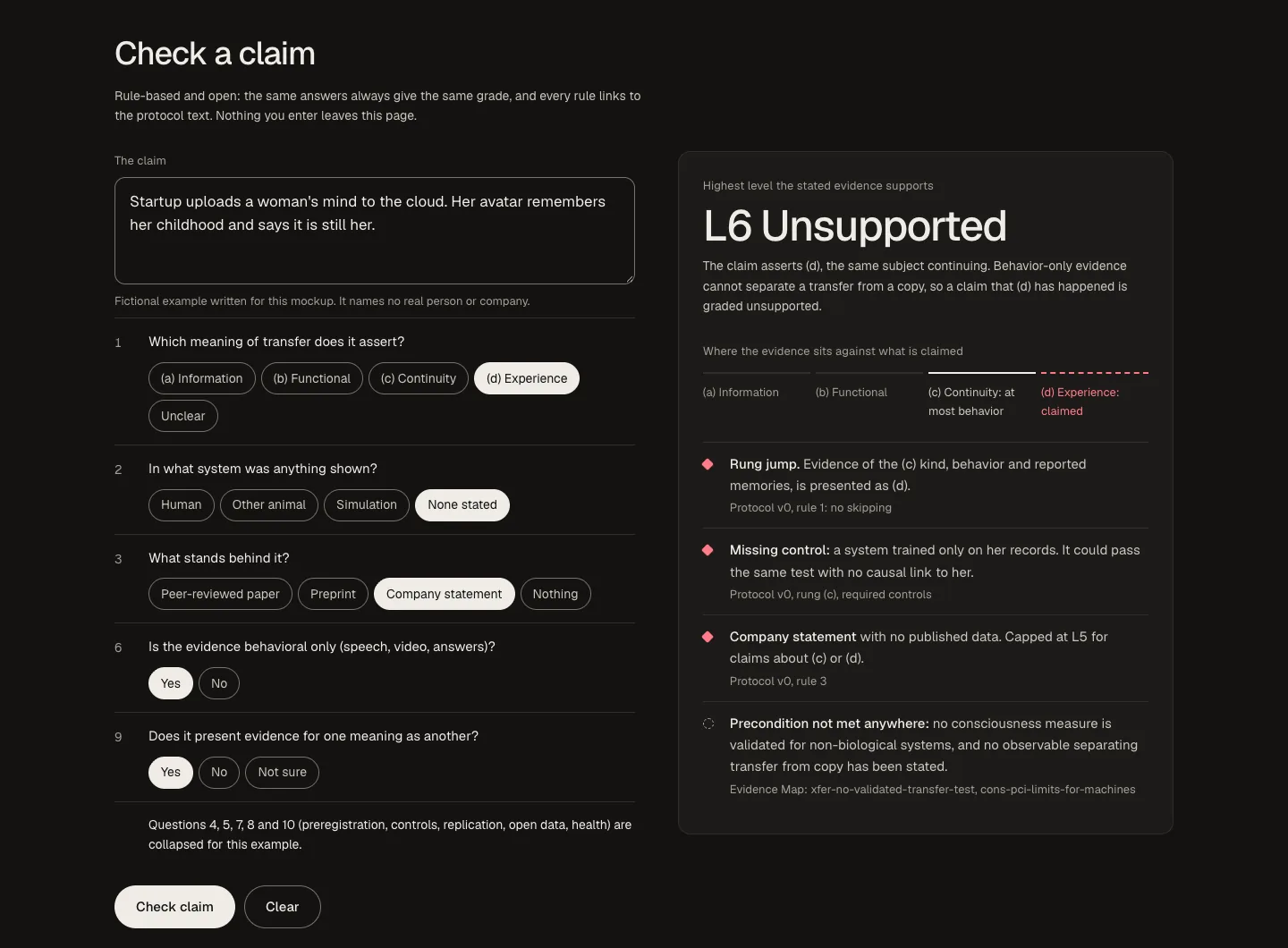
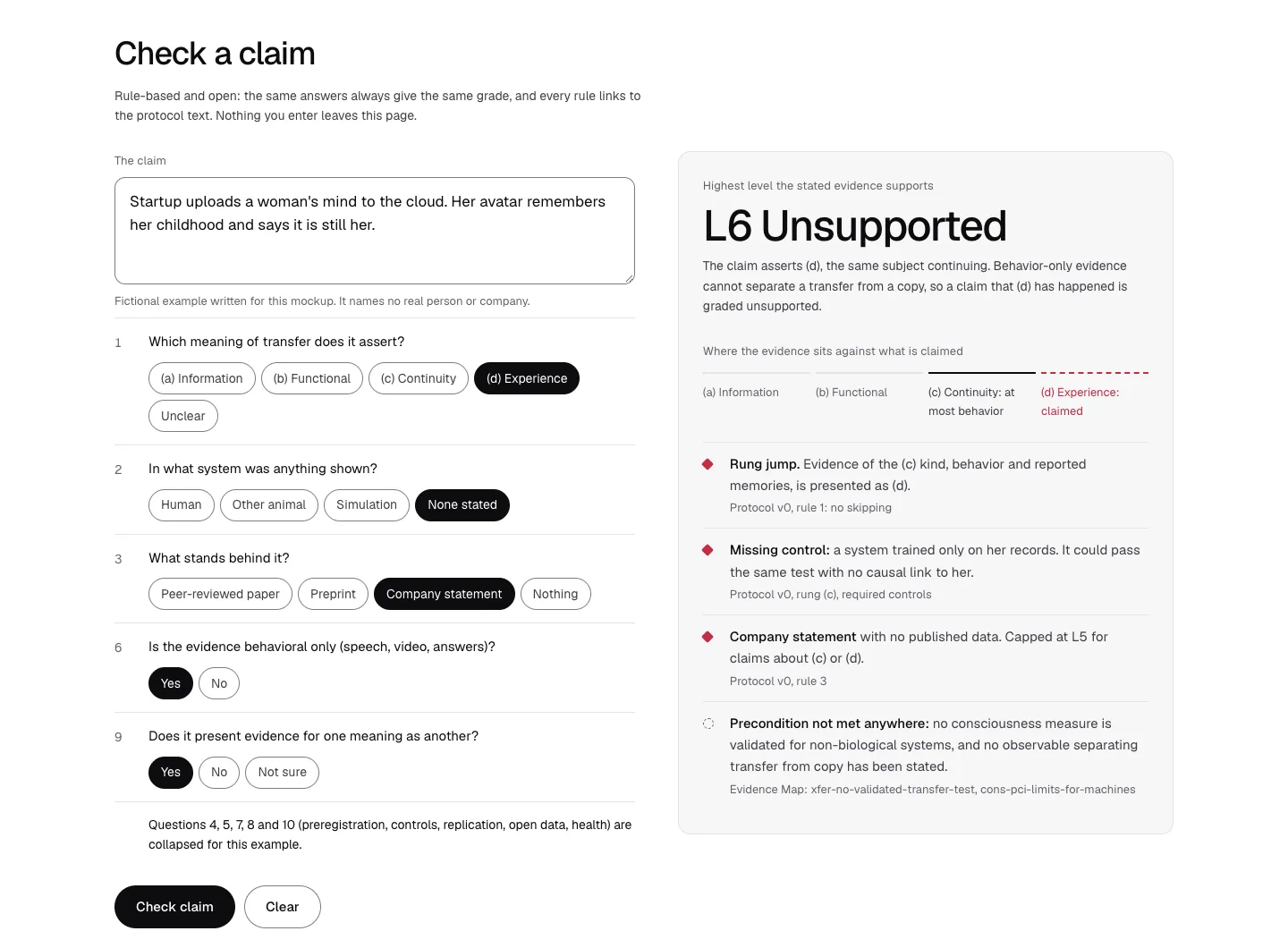
The design includes a claim checker that would apply the rules: ten questions about a claim return the meaning it asserts, the highest level its stated evidence supports and the controls it is missing. It is rule-based, with no AI model in the loop, and designed to run in the reader's browser and store nothing.
It also includes a theory lens that would set out what six major theories of consciousness imply for a faithful digital copy: integrated information, global neuronal workspace, recurrent processing, higher-order, predictive processing and attention schema. They disagree on whether a faithful copy would be conscious, and no experiment has settled it.
Design 3
Open EEG Bench.
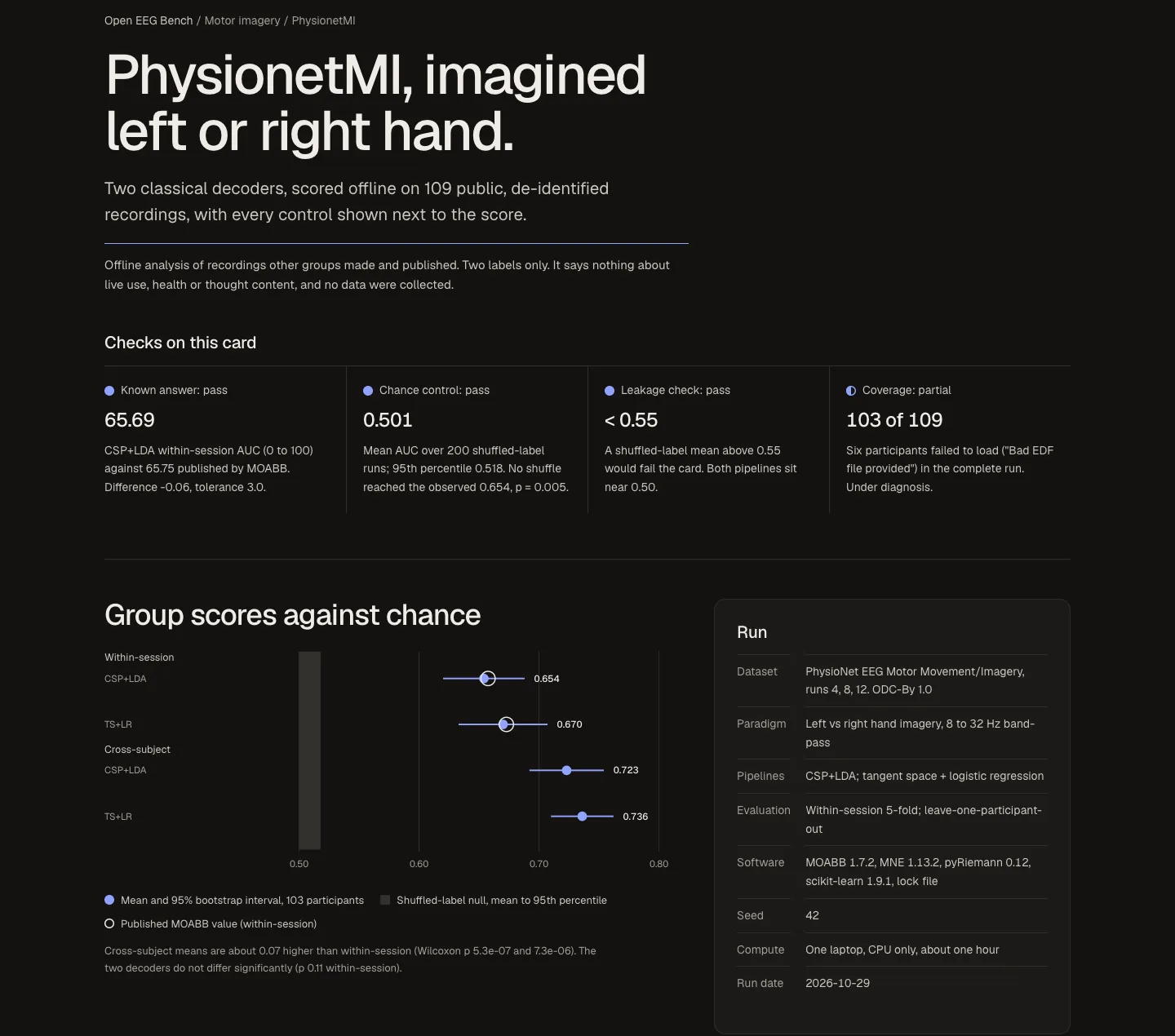
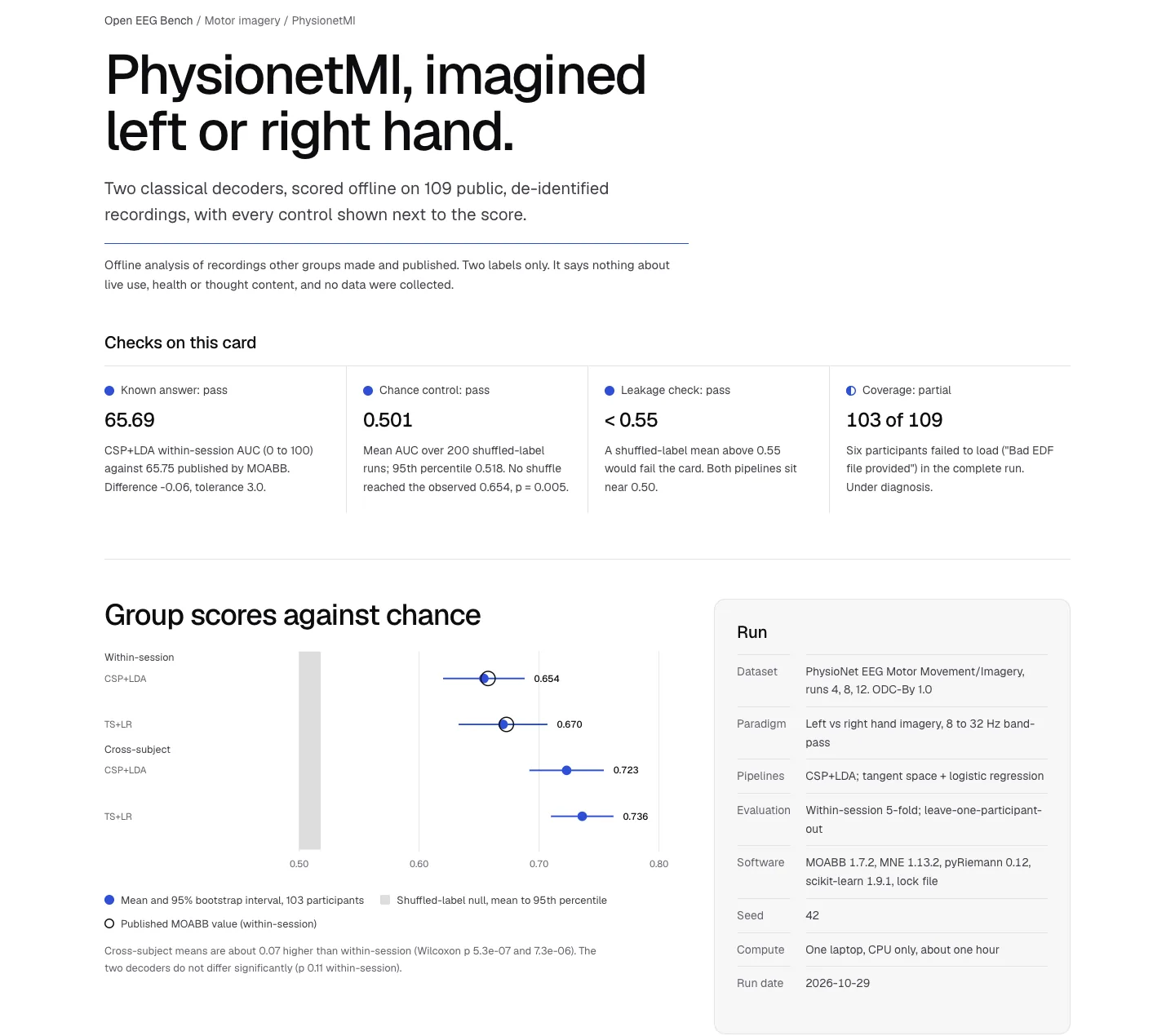
Standard motor-imagery decoders scored on public, de-identified EEG recordings. The bench is designed so that every score ships with its controls: a shuffled-label null, a known-answer check against a published value, a confidence interval and a count of participants who beat their own null.
Measured so far.
- Known answer
- On four dataset and decoder pairs, our 2026-10-29 reproduction landed within 0.06 points (AUC on a 0 to 100 scale) of the values the MOABB benchmark publishes.
- Group
- On the PhysioNet motor imagery recordings, imagined left versus right hand: group mean within-session AUC 0.654 and 0.670 for two classical decoders, clearly above chance at the group level.
- Individuals
- Only 41 and 42 of 103 participants scored above their own shuffled-label control. The recordings of six of the 109 participants did not load; diagnosing them is the first planned step.
Offline analysis of recordings other groups made and shared. It reads nothing from anyone, uses no device, and says nothing about live use, health or thought content.
What this is not.
- Not a product. It is desk research and software design on public data.
- Not medical advice. Nothing here claims that any device or method is safe or effective for anyone.
- Not a transfer claim. No transfer of a mind or of experience has been demonstrated, and no validated test could tell a transfer from a copy.
- No human or animal work. No experiments on people or animals, no implants, stimulation guidance or procedures, and no data collected from anyone. The EEG analysis uses only public, de-identified recordings other groups released. Human research belongs with qualified professionals, ethics oversight and the law.
Sources.
- Dorkenwald et al. 2024, Neuronal wiring diagram of an adult brain, Nature
- Shiu et al. 2024, A Drosophila computational brain model reveals sensorimotor processing, Nature
- Willett et al. 2023, A high-performance speech neuroprosthesis, Nature
- Bayne et al. 2024, Tests for consciousness in humans and beyond, Trends in Cognitive Sciences
- Cogitate Consortium 2025, Adversarial testing of global neuronal workspace and integrated information theories of consciousness, Nature
- Butlin et al. 2023, Consciousness in Artificial Intelligence (preprint)
- PhysioNet EEG Motor Movement/Imagery Dataset (Schalk et al.)
- Chevallier et al. 2024, The largest EEG-based BCI reproducibility study for open science: the MOABB benchmark (preprint)
Found an error in a grade or a source? Write to support@cadenvar.com.